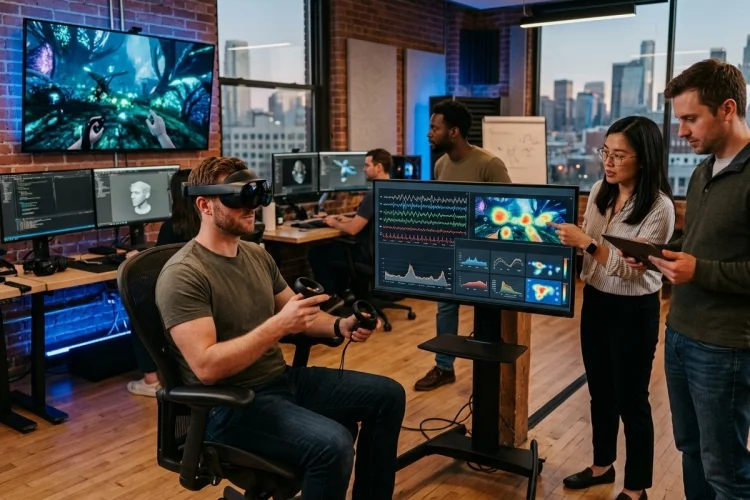
Ask someone whether a virtual experience felt real and they might say, “Yeah, pretty immersive.” That answer is useful, but it leaves developers with a big question: what exactly happened during the experience to create that feeling?
Modern immersive systems can capture head movement, gaze, interaction timing, controller behavior, and sometimes physiological signals. Advanced Presence Measurement brings those signals together with traditional self-report methods.
Instead of relying on one questionnaire after a session ends, teams can study how presence changes moment by moment-and potentially identify exactly where an experience becomes convincing or falls apart.
Why Self-Report Alone Has Limits
Questionnaires remain extremely valuable because presence is fundamentally connected to subjective experience.
If someone says they genuinely felt located inside a virtual environment, that report should not be ignored.
The limitation is timing.
Most presence questionnaires are completed after a session. The participant may have experienced strong presence during one scene, moderate presence during another, and a sudden disruption later. A final score compresses all of that into a retrospective judgement.
Recent research has highlighted this gap. A 2026 Frontiers paper argues that presence research still relies heavily on retrospective self-report and proposes a behavioral event-marker approach for observing presence as it happens.
That does not mean questionnaires should disappear.
It means they become one layer of evidence rather than the entire measurement strategy.
Add Behavioral Telemetry to the Picture
Immersive systems naturally generate behavioral data.
Headsets track orientation. Controllers record movement and button presses. Eye-tracking devices can capture gaze direction. Interaction systems know when users approach objects, hesitate, retreat, or attempt an action.
These signals create opportunities for presence analysis.
Suppose an experience contains a large virtual creature that suddenly approaches the participant. The system could examine whether the user moves backward, turns away, raises their hands, freezes, or continues behaving as if nothing happened.
Those reactions do not automatically prove presence. A behavioral responce may have several explanations.
However, when behavioral evidence agrees with questionnaire scores and observational data, the interpretation becomes stronger.
Researchers increasingly discuss the value of observable behavioral markers that occur at meaningful moments within immersive experiences rather than depending entirely on reports collected afterward.
Consider Physiological Signals Carefully
Physiological measurement introduces another layer.
Heart activity, electrodermal activity, muscle activity, motion tracking, and other signals can reveal changes associated with arousal, stress, attention, or physical engagement.
A comprehensive 2025 review analyzed 94 articles related to physiological presence measurement in VR.
Among studies using the major physiological methods examined in the review, ECG was reported most frequently, followed by electrodermal activity, EMG, and motion monitoring.
The important word here is context.
An elevated heart rate does not automatically mean stronger presence.
The participant may be nervous, excited by the narrative, physically active, uncomfortable, or simply reacting to a startling sound.
This is why physiological signals work better when combined with other evidence.
A high presence score, realistic avoidance behavior, and a physiological reaction occurring at the same narrative event tell a much richer story than heart-rate data by itself.
Synchronize Events Across Data Sources
Multimodal presence measurement becomes messy if the data cannot be aligned in time.
Imagine recording headset movement, frame timing, gaze data, interaction logs, heart activity, and researcher observations separately.
You later discover that presence dropped somewhere around minute twelve-but none of your clocks match.
That makes diagnosis painfully difficult.
A stronger system uses shared timestamps or synchronized event markers.
Important moments can be logged as events:
NPC_APPROACH_STARTED
TRACKING_LOSS
OBJECT_COLLISION
SCENE_TRANSITION
USER_REMOVED_HEADSET
Researchers can then examine what happened in the seconds before and after each event.
Good synchronisation transforms a pile of independent datasets into a timeline of the participant’s experience.
This approach is especially useful when identifying sudden disruptions.
Study Breaks in Presence as Diagnostic Events
Instead of measuring only how much presence users experienced, teams can study when presence breaks.
A break in presence occurs when attention shifts away from the mediated environment and the participant becomes noticeably aware of the physical world or technological interface.
Recent research continues to explore these moments because traditional questionnaires may show that presence was low without explaining exactly when or why the disruption happened.
For developers, breaks can be incredibly practical.
Suppose several users show behavioral disruption immediately after grabbing a virtual object. Session recordings reveal that the virtual hand briefly jumps because tracking becomes unstable.
Suddenly the presence problem is not philosophical at all.
It is a tracking bug.
Other breaks may come from visible loading, poorly placed UI elements, unnatural character responses, controller confusion, audio discontinuities, or physical discomfort.
Treating these moments as diagnostic events gives design and engineering teams specific problems to fix.
Separate Engagement From Presence
One of the biggest analytical mistakes is assuming engagement, enjoyment, and presence are identical.
A person can enjoy a game without feeling physically transported into its world.
Likewise, a highly convincing simulation may produce strong spatial presence even when the content itself is stressful or unpleasant.
Cross-media instruments such as the ITC-SOPI distinguish factors including physical-space presence and engagement rather than assuming they represent one construct.
This matters when interpreting telemetry.
Long session duration might indicate engagement, but it does not automatically prove spatial presence. Frequent interaction may reflect curiosity rather than realism. Increased gaze focus could indicate attention without a strong sensation of “being there.”
Advanced analysis requires resisting the temptation to turn every positive metric into a presence metric.
Protect Privacy When Collecting Immersive Data
Advanced measurement creates a less glamorous problem: immersive devices can collect extremely detailed information about human behavior.
Head motion, gaze patterns, facial signals, body movement, voice, physiological responses, and interaction history can be highly sensitive.
A 2024 review of multimodal XR technologies emphasizes privacy and data-governance concerns surrounding biometric, behavioral, cognitive, and other user data collected by immersive systems.
Presence studies should therefore collect only the data genuinely required.
Participants should understand what is being recorded and why. Identifying information should be separated when possible, access should be controlled, and retention periods should be defined.
More sensors do not automatically create better research.
Sometimes a well-designed questionnaire plus head movement and event telemetry answers the research question perfectly well.
Good Advanced Presence Measurement is selective, not invasive.
Build a Practical Presence Dashboard
For product development, the final goal should be actionable insight rather than an enormous research spreadsheet.
A presence dashboard might combine questionnaire dimensions, comfort scores, interaction success, major behavioral markers, technical performance, and reported breaks in presence.
Teams could compare these metrics across prototypes.
Imagine Version A scores higher in visual realism but produces more breaks because interaction latency is inconsistent. Version B uses simpler graphics but delivers smoother interaction and stronger spatial-presence ratings.
That comparision can influence where development resources should go next.
The best presence metric is not necessarily the fanciest one. It is the measurement that helps the team make a better design decision.
Advanced Presence Measurement becomes more useful when subjective reports, behavioral telemetry, physiological data, technical events, and privacy considerations are evaluated together.
No single signal perfectly captures the feeling of “being there.” Build a measurement stack that matches your experience, synchronize the data, and investigate breaks rather than chasing one universal score.
Your next immersive prototype may reveal far more once you start measuring what users actually experience.